Pla Rad Prik Recipe
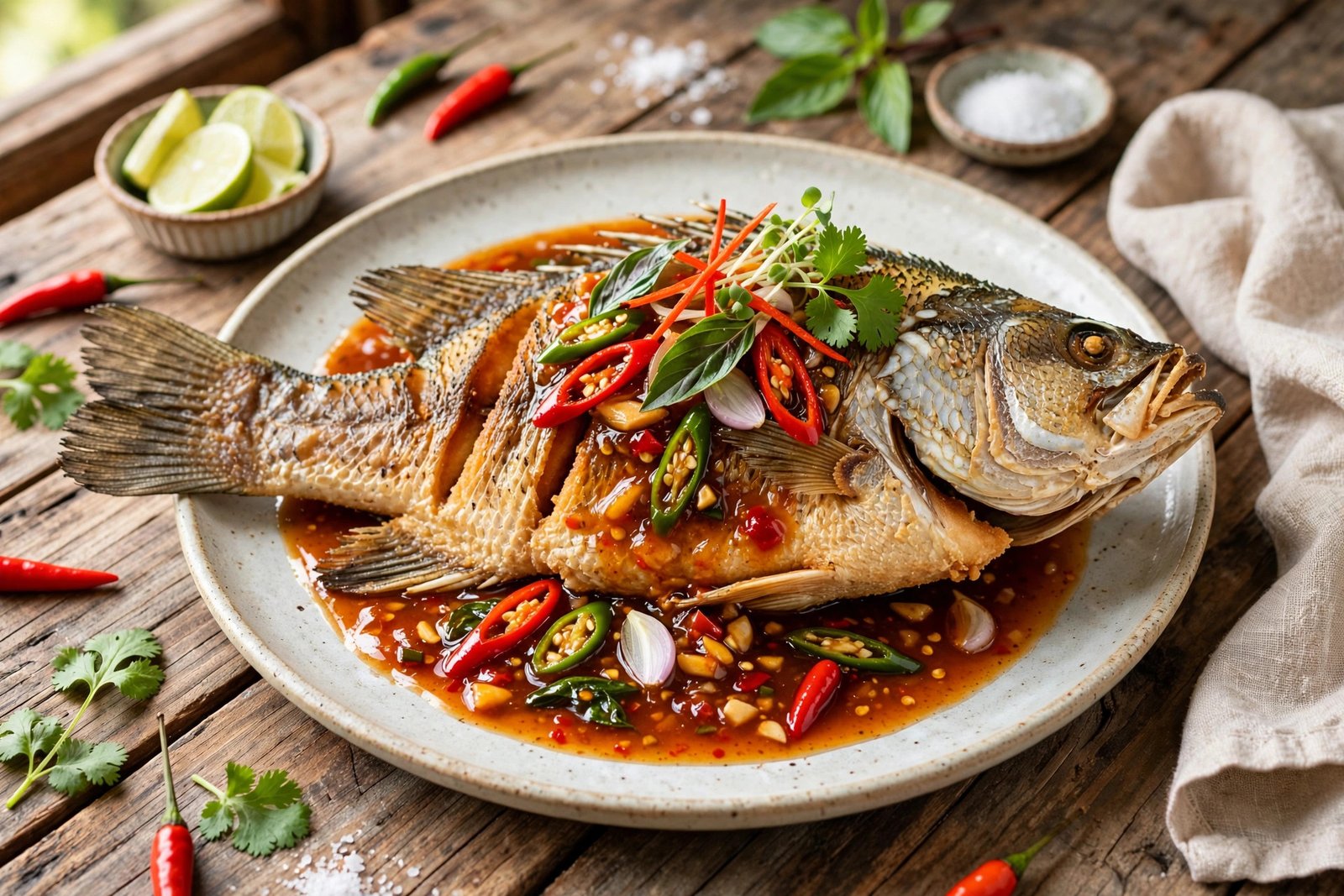
Crackling-crisp whole fish drowned in a sweet, spicy chilli sauce with fragrant basil — Pla Rad Prik is Thai street food at its most dramatic, and it arrives at the table looking like a celebration. The skin shatters, the sauce is sticky and bright, and the whole thing disappears fast. It is crunchy, fiery, and unforgettable.
The story behind Pla Rad Prik
Pla rad prik means fish topped with chilli, and in Thailand it is the kind of dish that turns heads when it arrives at the table. A whole fish, fried until the skin is crisp enough to shatter, dressed in a glossy sauce that is sweet, sour, salty and hot all at once — it is street food and celebration food at the same time. You will find it at open-air restaurants, at family gatherings, and at the seaside stalls where the fish was swimming that morning.
The dish sits at the meeting point of Thai and Chinese cooking. Whole fried fish is a Chinese tradition that travelled to Thailand centuries ago, and Thai cooks made it their own by adding the flavours of their own pantry: fish sauce, tamarind, chillies, and Thai basil with its faint aniseed note. The result is a dish that tastes unmistakably Thai — bright, bold, and built around the balance of sweet, sour, salty and hot that runs through so much of Thai cooking.
What makes it special is the contrast. The fish is fried hard and fast so the skin turns to a crisp shell, while the flesh inside stays moist and flaky. The sauce is poured over at the last moment, so you get soft, sticky sauce against crackling skin in the same bite. Thai basil wilts into the sauce and perfumes everything, and the lime at the table adds a final sharp note. It is dramatic food, and it is meant to be shared — the whole fish on a platter in the middle of the table, everyone picking at it with rice.
Cook it when you want to impress without much effort, or when you have found a really fresh fish at the market. It takes 40 minutes and most of that is heating oil and making a simple sauce. Serve it with jasmine rice and a cold drink, and do not worry about elegance — this is food for fingers and chopsticks, eaten with enthusiasm and a bit of mess.
- Prep time
- 15 mins
- Cook time
- 25 mins
- Total time
- 40 mins
- Servings
- 4 servings
- Calories
- 480
Ingredients
- 1 whole sea bass or snapper (about 1.5 lb), cleaned and scaled
- 1/2 cup cornstarch
- Oil, for deep-frying
- 3 cloves garlic, minced
- 2 red chilies, finely chopped
- 1 tablespoon fish sauce
- 2 tablespoons sugar
- 1 tablespoon tamarind paste
- 1/4 cup water
- 1 cup Thai basil leaves
- 1 red bell pepper, thinly sliced
- Lime wedges, to serve
- Steamed jasmine rice, to serve
Instructions
- Score the fish deeply on both sides with diagonal cuts, about an inch apart, cutting down to the bone. This helps the fish cook evenly and lets the sauce seep into the flesh later. Pat the fish very dry with paper towels, inside and out, then dust it evenly with cornstarch, rubbing it into the scores. Dry skin is the whole secret to crisp fish.
- Heat 2 inches of oil in a large wok or deep pan to 375°F (190°C) — the oil should shimmer and a pinch of cornstarch should sizzle fiercely on contact. If you do not have a thermometer, test with a small piece of bread: it should turn golden in about 30 seconds. Line a wire rack with paper towels nearby.
- Lower the fish into the oil carefully, away from you, and fry for 6 to 7 minutes per side without moving it much. The skin will bubble and turn deep golden. Turn it once, gently, with tongs and a spatula — a whole fish is awkward, so take your time. Lift it out when the skin is crisp and the flesh flakes easily, and drain on the wire rack.
- While the fish drains, make the sauce. Heat 1 tablespoon of oil in a small pan over medium heat and cook the garlic and chillies for about 1 minute, stirring, until fragrant. Do not let the garlic brown — it should smell sweet and toasty, not burnt.
- Add the fish sauce, sugar, tamarind paste and water, and stir until the sugar dissolves. Simmer for about 3 minutes, stirring now and then, until the sauce thickens into a syrupy glaze that coats the back of a spoon. Taste it — it should be sweet, sour and salty all at once, with the heat arriving last.
- Stir in the sliced bell pepper and half the basil leaves and cook for 1 minute more, just until the pepper softens slightly and the basil wilts. The pepper should still have some bite — it is there for crunch and colour as much as flavour.
- Place the crispy fish on a serving platter and pour the hot chilli sauce over the top, letting it run down the sides and pool around the base. Work quickly and serve immediately — the sauce will soften the skin if it sits too long, and the whole point of this dish is the contrast between the crisp fish and the sticky sauce.
- Scatter the remaining basil leaves over the fish and serve straight away with lime wedges and plenty of steamed jasmine rice. Squeeze lime over each portion at the table — the acidity lifts the whole dish and cuts through the richness of the fried fish.
Pro tips
- Dry the fish thoroughly before dusting — wet skin and hot oil do not mix, and damp fish will never crisp properly.
- The oil must be hot enough that the fish sizzles hard on contact; if it goes in quietly, wait for the oil to come up to temperature.
- Pour the sauce over the fish only at serving time so the skin stays crisp — even 5 minutes of sitting softens it.
- Score deeply so the fish cooks evenly and the sauce seeps into the flesh; shallow scores leave the centre undercooked.
- Use Thai basil if you can find it — its faint aniseed note is part of the dish. Italian basil works, but the flavour is different.
Variations & serving ideas
Thick fish fillets are the easiest variation — fry them for 3 to 4 minutes per side and you get the same flavours with much simpler eating. Sea bass, snapper, tilapia and even cod all work, though firmer fish hold up better in the fryer. If whole fish feels like too much work on a weeknight, fillets are the sensible choice, and nobody at the table will complain.
The sauce is flexible too. For more heat, leave the seeds in the chillies or add a third one; for a milder version, use one chilli and a little extra sugar. A spoonful of chilli paste or sriracha stirred into the sauce gives a different kind of warmth. Some cooks add sliced onion or a few cherry tomatoes with the bell pepper, which makes the sauce more substantial and turns the dish into more of a one-plate meal.
If deep-frying is not your thing, the fish can be baked or air-fried instead. Brush it generously with oil and bake at 425°F (220°C) for about 20 minutes, or air-fry at 400°F (200°C) for 12 minutes, turning once. The skin will not be as shattering as the fried version, but it will still be crisp, and the sauce carries so much flavour that the dish works beautifully either way.
For serving, jasmine rice is the essential partner, but a simple cucumber salad with rice vinegar and a pinch of sugar makes a cooling side that balances the heat. A cold beer or a sparkling lime soda is the right drink. Keep the rest of the meal light — the fish is rich and dramatic, and it does not need competition.
Getting it right
Drying the fish is the single most important step. Wet skin and hot oil are enemies: the water turns to steam, drops the oil temperature, and the skin goes soggy instead of crisp. Pat the fish dry with paper towels, inside and out, then dust it evenly with cornstarch, working it into the scores. The cornstarch forms a thin, dry layer that fries into a crisp shell. If the fish still feels damp after patting, leave it uncovered in the fridge for 20 minutes — the cold air dries the skin nicely.
Oil temperature is the second thing to get right. The oil needs to be at about 375°F (190°C) when the fish goes in, and it needs to stay hot. A thermometer takes the guesswork out, but the bread test works too — a small cube should turn golden in about 30 seconds. If the oil is too cool, the fish absorbs it and turns greasy; too hot, and the skin burns before the flesh cooks. Fry in a wok if you have one, since the curved shape lets you use less oil and turn the fish more easily.
The sauce is simple but it needs attention. Simmer it until it thickens into a syrupy glaze that coats a spoon — about 3 minutes — and taste it before you pour. It should be sweet first, then sour and salty, with the heat arriving last. If it is too sharp, add a little more sugar; if it is too sweet, a squeeze of lime fixes it. And pour the sauce over the fish only at the moment of serving — every minute it sits, the skin softens, and the crispness is what makes this dish worth making.
Storing & reheating
Pla rad prik is at its best eaten immediately — the crisp skin is the whole point, and it softens within half an hour of saucing. If you do have leftovers, refrigerate the fish and any sauce separately for up to 2 days. Reheat the fish in a hot oven at 400°F (200°C) for about 8 minutes to crisp the skin back up, and warm the sauce separately before spooning it over.
The sauce itself keeps well: refrigerate it in a jar for up to a week, or freeze it for up to 3 months. It is good spooned over grilled chicken, fried tofu, or even roasted vegetables, so it is worth making a double batch. Do not freeze the fried fish — the texture never recovers, and it is not worth the freezer space.
Frequently asked questions
What fish is best for pla rad prik?
Sea bass, snapper, or tilapia all work well. Choose a whole fish with firm flesh that crisps beautifully when fried. The fish should be fresh — clear eyes, firm flesh, and no strong smell — because frying shows up the quality of the fish more than most cooking methods.
Can I use fish fillets instead of a whole fish?
Yes — use thick fillets and fry for 3 to 4 minutes per side. The presentation is simpler, but the flavour is the same. Fillets are easier to eat and quicker to cook, which makes them a good choice for a weeknight version of the dish.
Is pla rad prik very spicy?
It has a warm, sweet heat from the chillies, balanced by sugar and tamarind. Reduce the chillies to one for a milder version, or leave the seeds in for more fire. The sauce is meant to be sweet first and spicy second, so taste as you go.
What is tamarind paste?
A sour, fruity paste made from tamarind fruit. It gives the sauce its signature tang — lime juice is the best substitute, though it is sharper and less rounded. Tamarind paste keeps for months in the fridge and is worth having in the cupboard.
Can I air-fry the fish instead?
Yes, though the result is different. Brush the fish with oil and air-fry at 400°F (200°C) for about 12 minutes, turning once. The skin gets crisp but not as shattering as deep-fried. It is a good lighter option, and the sauce carries plenty of flavour either way.
What should I serve with it?
Steamed jasmine rice is the essential partner — it soaks up the sauce and cools the heat. A simple cucumber salad with a little vinegar and sugar is a good cooling side, and lime wedges are non-negotiable. Keep the rest of the meal simple and let the fish be the star.