Gai Yang Recipe
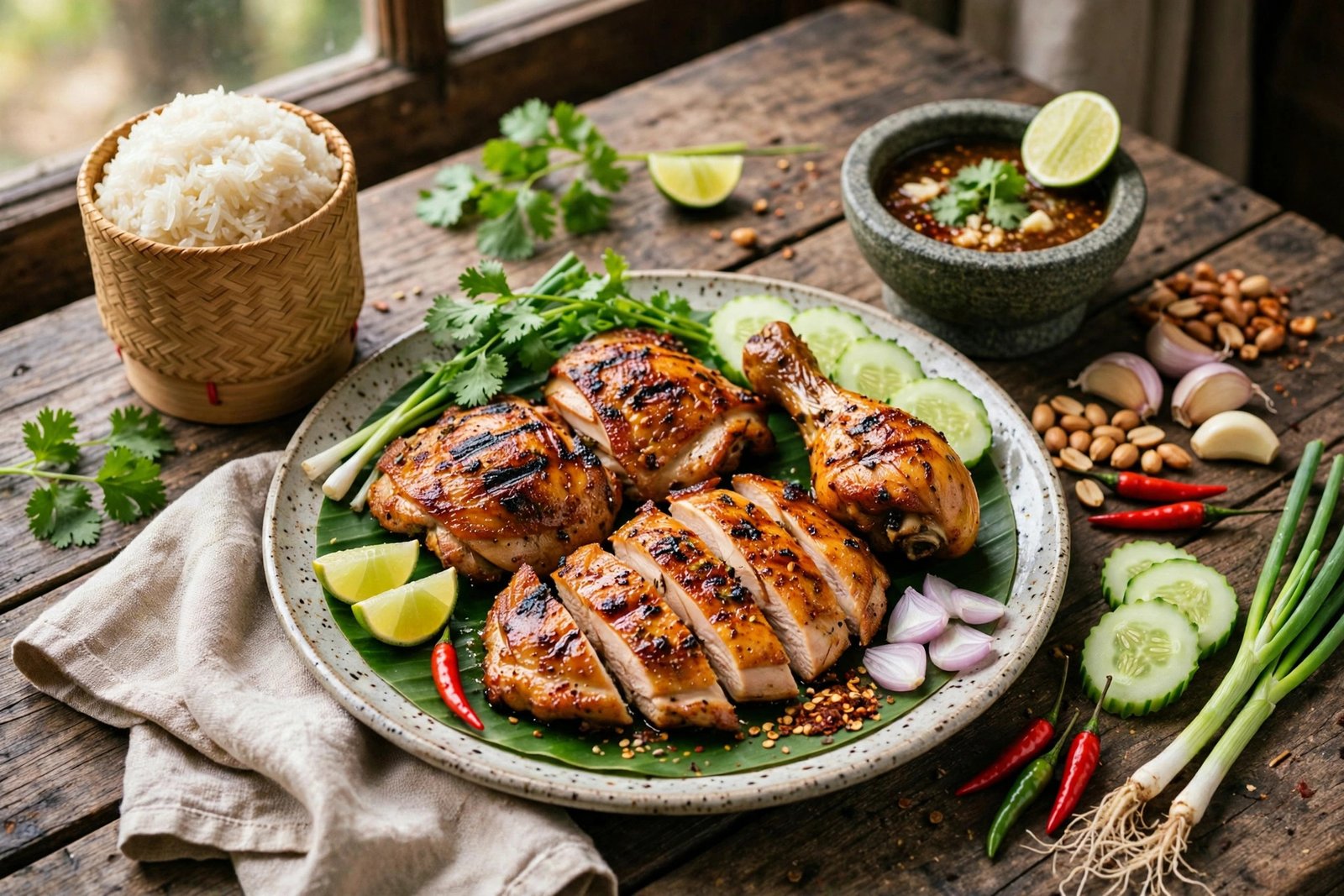
Gai Yang is Thailand's smoky grilled chicken, marinated in lemongrass, garlic, coriander root and fish sauce, then grilled until charred at the edges and juicy inside. It is fragrant, savoury and deeply comforting. Serve it with sticky rice and a spicy dipping sauce for an authentic Thai street-food feast.
The story behind Gai Yang
Gai Yang is Thailand's grilled chicken, and it is one of the great street foods of Southeast Asia. A whole chicken, butterflied, marinated in lemongrass, garlic, coriander root and fish sauce, then grilled over charcoal until charred at the edges and juicy inside. It is fragrant, savoury and deeply comforting.
The marinade is the heart of it. Lemongrass, garlic, coriander root and black peppercorns, pounded into a paste, then mixed with fish sauce, soy sauce, oyster sauce, palm sugar and turmeric. The marinade is rubbed all over the chicken, under the skin as well, and left overnight so the flavours penetrate deep into the meat.
Gai Yang comes from Isan, the northeast of Thailand, where it is sold from street carts and market stalls. The chicken is grilled over charcoal, which gives it a smoky flavour and a charred, crispy skin. It is served with sticky rice and a spicy dipping sauce, usually nam jim jaew, a sauce of dried chillies, fish sauce and lime.
The butterflying is important. A butterflied chicken cooks evenly, picks up more char, and is easier to grill than a whole bird. The flat shape means the heat reaches all parts of the chicken at the same time, so the breast and the thighs finish together.
This recipe takes about fifty minutes of cooking, plus overnight marinating. The marinating is hands-off, and the grilling is straightforward. It serves four, and it is a complete meal with sticky rice and a salad.
Gai Yang is a dish for a summer evening, for a barbecue, and for anyone who loves grilled chicken. It is fragrant, smoky and juicy, and it is a taste of Thailand. Cook it when you want a grilled chicken that is far from ordinary.
The chicken is best eaten with your hands, torn into pieces and dipped in the sauce, with sticky rice to fill you up. It is street food, and it is meant to be messy and fun. Do not try to eat it politely: pick it up, dip it, and enjoy it.
One more thing worth knowing: Gai Yang is a dish that is best eaten outdoors, with your hands, and with plenty of sticky rice. It is street food, and it is meant to be messy and fun. Do not try to eat it politely with a knife and fork: pick up a piece, dip it in the sauce, and enjoy it. That is how it is meant to be eaten.
The chicken is also a good dish for a barbecue party. Grill two or three chickens, serve them on a platter with sticky rice and dipping sauces, and let guests help themselves. The food is always hot, the atmosphere is relaxed, and everyone eats well.
The chicken is also a good dish to cook for guests. It looks impressive when you bring it to the table, whole and charred, and carve it in front of everyone. The aroma is wonderful, and the chicken tastes like you spent hours on it. Nobody needs to know the marinade did most of the work.
- Prep time
- 20 mins
- Cook time
- 30 mins
- Total time
- 50 mins
- Servings
- 4 servings
- Calories
- 480
Ingredients
- 1 whole chicken (about 1.5 kg), butterflied
- 3 lemongrass stalks, white parts only, chopped
- 4 garlic cloves
- 2 coriander roots, chopped
- 1 tablespoon black peppercorns
- 2 tablespoons fish sauce
- 1 tablespoon soy sauce
- 1 tablespoon oyster sauce
- 1 tablespoon palm sugar (or brown sugar)
- 1 teaspoon turmeric powder
- 2 tablespoons vegetable oil
- Sticky rice and dipping sauce, to serve
- Salt to taste
Instructions
- Pound the lemongrass, garlic, coriander roots and black peppercorns into a coarse paste using a pestle and mortar or a small food processor. The paste should be fragrant and well-combined, with no large pieces of lemongrass remaining.
- Stir in the fish sauce, soy sauce, oyster sauce, palm sugar, turmeric and vegetable oil to make the marinade. Mix well until the sugar dissolves and the marinade is smooth. Taste it: it should be salty, sweet and fragrant.
- Rub the marinade all over the butterflied chicken, working it under the skin as well. Use your hands to massage the marinade into the meat. Cover and refrigerate overnight, or for at least 4 hours. The longer the marinade, the deeper the flavour.
- Bring the chicken to room temperature 30 minutes before cooking. Cold chicken will cook unevenly on the grill. Preheat a barbecue or grill to medium-high heat. The coals should be glowing, with a light layer of ash.
- Grill the chicken skin-side down for 15 minutes, until the skin is charred and crispy. Do not move it around: let it develop colour. Turn the chicken and grill for another 15 minutes, until the juices run clear and the internal temperature reaches 74 degrees.
- Rest the chicken for 10 minutes before carving so the juices settle. Resting is essential: cutting into the chicken immediately will let the juices run out and dry the meat. Cover it loosely with foil while it rests.
- Carve the chicken into pieces and serve with sticky rice and your chosen dipping sauce. The chicken should be juicy, fragrant and charred at the edges. Serve immediately while hot.
Pro tips
- Butterflying the chicken helps it cook evenly and pick up more char. A flat chicken cooks faster and more evenly than a whole bird. Ask your butcher to butterfly it, or do it yourself with kitchen shears.
- Marinate overnight for the deepest flavour; 4 hours is the minimum. The marinade needs time to penetrate the meat, especially under the skin. Overnight is ideal, but 4 hours will give a good result.
- Rest the chicken before carving to keep it juicy. Ten minutes is enough. The juices redistribute through the meat during resting, and the chicken will be noticeably juicier. Do not skip this step.
- Brush with a little extra marinade during grilling for a glossier finish. Reserve some marinade before it touches the raw chicken, and brush it on during the last few minutes of grilling. The sugar in the marinade will caramelise and give a glossy finish.
- Use charcoal if you can. Charcoal gives a smoky flavour that a gas grill cannot match. If you are using a gas grill, add a few wood chips to the grill for smoke.
Variations & serving ideas
The chicken can be replaced with chicken thighs or drumsticks, which are easier to grill and cook faster. Marinate them the same way and grill for 10 to 12 minutes per side. The thighs are juicier and more forgiving than a whole chicken.
For a spicier version, add a few dried chillies to the marinade paste. The chillies add heat and a smoky depth. A spoon of chilli sauce in the dipping sauce adds more heat. Adjust to your taste.
The dipping sauce can be nam jim jaew, the classic spicy dried-chilli sauce, or sweet chilli sauce, which is milder and sweeter. A simple sauce of fish sauce, lime juice and chopped chillies is also good. Serve the sauce on the side for dipping.
Serve Gai Yang with sticky rice, which is the classic partner, and a green papaya salad, som tam, for a complete Isan meal. The salad is fresh, spicy and sour, and it balances the rich, smoky chicken.
Leftover Gai Yang makes a wonderful sandwich or salad. Shred the chicken, toss it with the dipping sauce, and serve it in a roll or over greens. The smoky flavour holds up well, and the chicken is just as good cold.
For a party, grill two chickens and serve them on a platter with sticky rice, dipping sauces and salads. Let guests carve their own pieces and build their own plates. It is interactive, fun, and the food is always hot.
For a different flavour, add a spoon of curry paste to the marinade. The curry paste adds depth and complexity, and it turns the chicken into a curried grilled chicken. Red curry paste is spicy, green curry paste is fragrant. Try both and find your favourite.
Getting it right
Pounding the marinade paste is the foundation. A pestle and mortar gives the best texture: a coarse paste with the lemongrass, garlic and coriander root well-combined. A food processor works too, but pulse it briefly: over-processing gives a smooth paste that does not cling to the chicken as well.
Working the marinade under the skin is essential. The skin protects the meat, but it also blocks the marinade. Loosen the skin gently with your fingers and push the marinade underneath, so it flavours the meat directly. Rub the rest over the skin.
Grilling over medium-high heat gives a charred, crispy skin and juicy meat. Too hot and the skin burns before the inside cooks. Too cool and the skin will be soft and the chicken will take too long. The coals should be glowing, with a light layer of ash.
Turning the chicken once is enough. Fifteen minutes skin-side down, then fifteen minutes skin-side up. Do not flip it repeatedly: each flip lets heat escape and prevents the skin from crisping. Let it cook undisturbed on each side.
Resting the chicken is the final skill. Ten minutes, covered loosely with foil, lets the juices redistribute through the meat. Cutting into the chicken immediately will let the juices run out onto the cutting board. Patience gives a juicier result.
The charcoal should be glowing, with a light layer of ash, before the chicken goes on. If the coals are still flaming, the chicken will burn. Wait until the flames die down and the coals are evenly glowing. The heat should be medium-high, not fierce.
Storing & reheating
Leftover Gai Yang keeps in the fridge for up to three days in a sealed container. Reheat it in the oven at 180 degrees for 10 minutes, until hot through. The skin will not be as crisp as fresh, but the chicken will still be flavourful.
The chicken can be shredded and used in salads, sandwiches or fried rice. The smoky flavour holds up well, and the chicken is just as good cold as it is hot. Shred it and keep it in the fridge for up to three days.
The marinade, made fresh, keeps in the fridge for up to a week in a sealed jar. Use it to marinate other meats: pork, beef or tofu all work well. The marinade is versatile, and it is worth making a double batch.
If you have leftover dipping sauce, use it as a dressing for salads or noodles. The sauce is spicy, tangy and savoury, and it works well with many dishes. Keep it in the fridge for up to a week in a sealed jar.
Frequently asked questions
Can I make Gai Yang without a barbecue?
Yes, a grill pan or the oven grill works well. Cook at 200 degrees for 25 to 30 minutes, turning once, until the skin is crisp. The flavour will be less smoky, but still delicious.
Can I marinate the chicken for less time?
Yes, but do not skip the overnight rest if you can help it; the long marinade is what makes the chicken so flavourful. Four hours is the minimum for a good result.
What dipping sauce goes with Gai Yang?
The classic partner is nam jim jaew, a spicy dried-chilli dipping sauce, but sweet chilli sauce is also delicious. A simple fish sauce, lime and chilli sauce is also good.
What is coriander root?
Coriander root is the root of the coriander plant, used in Thai cooking for its earthy, fragrant flavour. It is sold in Asian grocery shops. If you cannot find it, use coriander stems instead.
Can I use chicken pieces instead of a whole chicken?
Yes, thighs and drumsticks work well and cook faster. Marinate them the same way and grill for 10 to 12 minutes per side. The thighs are juicier and more forgiving.
What do you serve with Gai Yang?
Sticky rice is the classic partner, with a green papaya salad, som tam, for a complete Isan meal. The salad is fresh, spicy and sour, and it balances the rich, smoky chicken.


