Samgyeopsal Gui Recipe
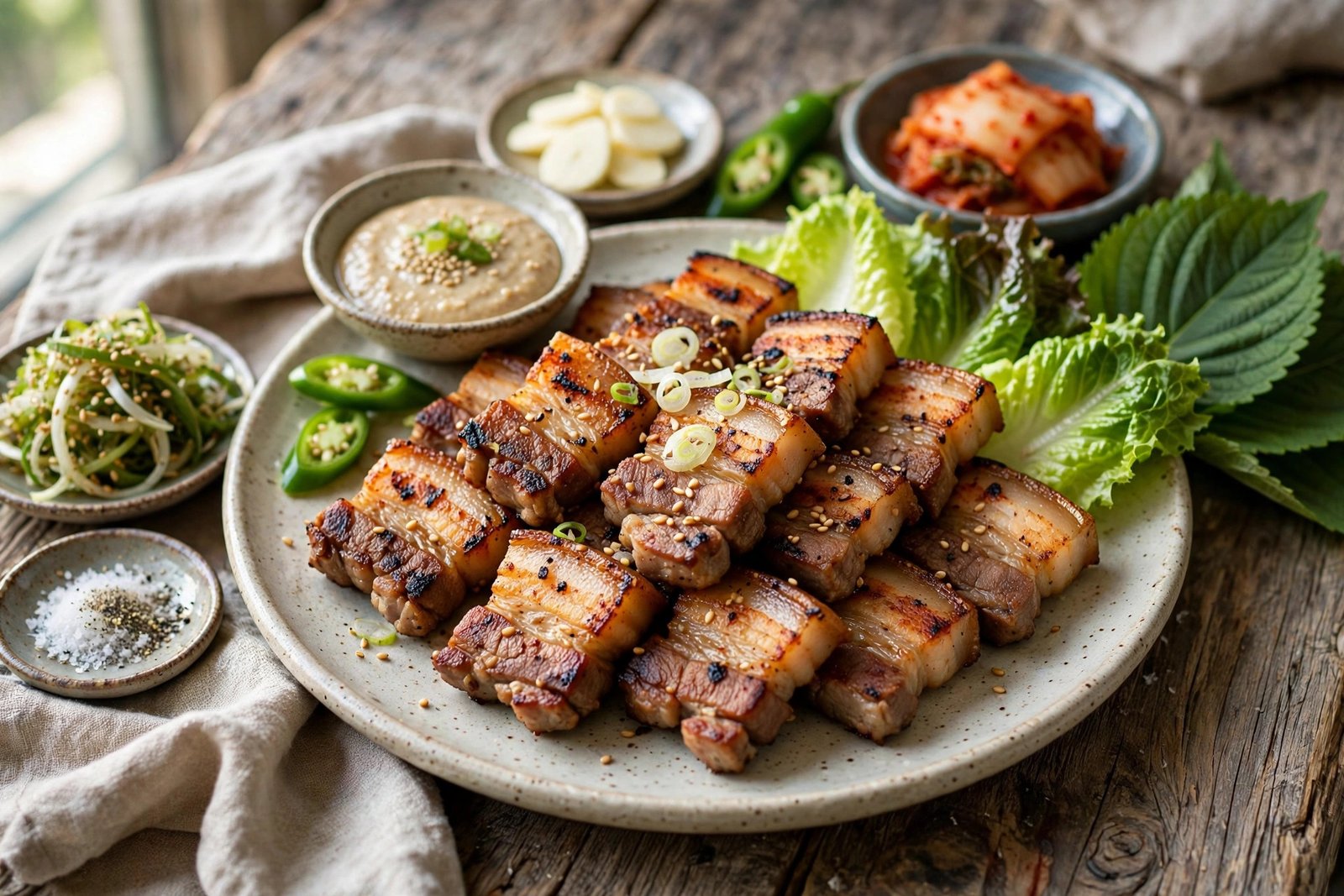
Samgyeopsal gui is the heart of Korean barbecue: thick slices of pork belly grilled until crisp-edged and juicy, then wrapped in lettuce with ssamjang, garlic, and kimchi. It is interactive, smoky, and made for sharing around the table — the meal that turns dinner into an occasion.
The story behind Samgyeopsal Gui
Samgyeopsal means three-layer flesh, named for the three visible layers of meat and fat in a slice of pork belly. It rose to fame in Korea in the 1970s and 80s, when pork belly was cheap and plentiful, and it has been the country's most beloved barbecue dish ever since. March 3rd — 3/3, sam-sam — is Samgyeopsal Day, a made-up holiday that Koreans celebrate with genuine enthusiasm, grilling pork belly at restaurants and at home.
What makes it special is the ritual. The pork is unseasoned — just thick slices of belly, grilled over high heat until the fat renders and the edges go crisp and golden. Then comes the ssam, the wrap: a lettuce leaf, a piece of pork, a dab of ssamjang, a slice of garlic, a piece of kimchi, folded into a parcel and eaten in one bite. The richness of the pork, the sharpness of the kimchi, the salt of the ssamjang and the crunch of the lettuce all arrive at once, and the balance is the whole point. The pork itself is deliberately plain — no marinade, no seasoning beyond a pinch of salt — because the flavour comes from the grill, the fat, and the things you wrap it with. It is a dish that trusts its ingredients completely.
In Korea, samgyeopsal is social food. It is the centrepiece of hoesik, the work dinner, and of gatherings with friends, where the grill sits in the middle of the table and everyone cooks together. The grilling is part of the evening — someone tends the meat, someone else pours the soju, and the conversation happens around the smoke. A meal of samgyeopsal is never rushed, and it is never eaten alone.
This recipe serves four and takes about half an hour, most of it at the table. It needs a grill pan or a barbecue, a pile of lettuce leaves, and the accompaniments laid out in small bowls. Set it up, heat the grill, and let everyone cook their own — the best samgyeopsal is the one you grill yourself, exactly the way you like it.
- Prep time
- 15 mins
- Cook time
- 20 mins
- Total time
- 35 mins
- Servings
- 4 servings
- Calories
- 620
Ingredients
- 600 g thick-cut pork belly slices
- 1 tablespoon sesame oil
- 2 garlic cloves, thinly sliced
- 1 onion, sliced into rings
- 1 green chilli, sliced
- 8 large lettuce leaves
- 4 tablespoons ssamjang
- 100 g kimchi
- 2 spring onions, chopped
- 1 teaspoon toasted sesame seeds
- Steamed rice, to serve
Instructions
- Prepare the pork. Cut the pork belly into thick slices, about 1 cm thick, or buy it pre-sliced from a Korean grocery store. Thick slices stay juicy inside while the edges crisp; thin slices dry out and curl. Pat the slices dry with kitchen paper — a dry surface sears better than a wet one.
- Brush the pork belly slices lightly with sesame oil and season with a pinch of salt. The sesame oil adds fragrance and helps the pork brown; the salt is light, because the ssamjang and kimchi will bring plenty of salt to the finished wrap.
- Heat a grill pan, cast-iron pan or barbecue over a high heat until it is very hot — a drop of water should sizzle and evaporate instantly. Open a window if you are cooking indoors, as grilling pork belly produces smoke. Do not oil the pan; the pork renders more than enough fat. The pan is ready when a drop of water dances across the surface and evaporates in a second.
- Lay the pork slices on the grill in a single layer, with space between them. Grill for 3 to 4 minutes per side, without moving them, until deeply golden and crisp at the edges. The fat will render and sizzle, and the edges will curl and brown. Turn once, with tongs, and grill the second side the same way.
- Grill the sliced garlic, onion rings and green chilli alongside the pork for the last 2 minutes. The garlic should turn golden at the edges, the onion should soften and char slightly, and the chilli should blister. These go into the wraps with the pork, so grill enough for everyone.
- Rest the pork for 2 minutes off the heat, then cut it into bite-size pieces with kitchen scissors — the traditional Korean way to cut grilled meat at the table. The scissors give neat, even pieces and they are part of the ritual. Pile the cut pork on a warm plate.
- To eat, take a lettuce leaf in your palm and place a piece of pork on it, with a little kimchi, a slice of grilled garlic, a piece of chilli, and a dab of ssamjang. Fold the leaf into a parcel and eat it in one bite. The whole wrap should be small enough to eat in a single mouthful — that is the rule, and it is what makes the flavours arrive together.
- Serve with steamed rice, chopped spring onions and toasted sesame seeds on the side. Keep grilling in batches as people eat — the grill stays hot, the pork keeps coming, and the meal goes on as long as anyone is hungry.
Pro tips
- Cut the pork belly thick, about 1 cm, so it stays juicy inside while the edges crisp. Thin slices dry out and curl on the grill; thick slices render their fat slowly and stay tender. If your butcher will cut it for you, ask for 1 cm slices.
- Do not move the pork too much on the grill; let it develop a proper sear. A piece left alone for 3 to 4 minutes builds a deep golden crust; a piece fussed over and flipped constantly never browns properly. Put it down, leave it, turn it once.
- Kitchen scissors are the traditional Korean way to cut grilled meat at the table. They are faster and neater than a knife and fork, and they are part of the experience. Keep a pair by the grill and cut the pork as it comes off.
- Keep the lettuce leaves cold and crisp so they hold up to the hot pork. Wash them, dry them well, and keep them in the fridge until serving time. A limp, warm lettuce leaf tears when you fold it; a cold, crisp one holds the wrap together.
- Do not overload the wrap. A good ssam is small enough to eat in one bite, with a little of everything in it. An overstuffed wrap falls apart, and the flavours arrive separately instead of together. Less is more, and you can always make another. One bite, all the flavours at once — that is the whole point of the ssam.
Variations & serving ideas
Marinated versions are popular too. A gochujang marinade — gochujang, soy sauce, sugar, garlic and sesame oil, rubbed on the pork for 30 minutes — gives a sweet, spicy crust. A doenjang marinade gives a deeper, more savoury flavour. The classic samgyeopsal is unseasoned, but the marinated versions are worth trying when you want a change.
Other cuts work on the same grill. Moksal, pork neck, is the closest alternative — it has a similar fat content and grills the same way. Thinly sliced beef, marinated in soy and sesame, is a different dish but the same ritual. And mushrooms, sliced thick and grilled until golden, are a fine vegetarian option for the same wraps.
What you grill alongside the pork matters. Mushrooms, kimchi and garlic are the classics — kimchi grilled on the hot plate turns smoky and slightly caramelised, and it is one of the best things on the table. Onion rings, sliced courgette, and whole spring onions are all good on the grill too. A spoonful of kimchi fried on the grill alongside the pork, until it is smoky and slightly charred, is one of the best things on the table — the heat transforms the kimchi from sharp and sour to deep and savoury.
The wraps can change as well. Perilla leaves, with their minty, herbal flavour, are the traditional alternative to lettuce, and they are worth seeking out. Cabbage leaves, blanched briefly, make sturdier wraps. And ssamjang can be made at home: mix doenjang and gochujang in equal parts with minced garlic, sesame oil, a little sugar and chopped spring onion, and it keeps for weeks in the fridge.
Getting it right
Searing is the technique, and it needs high heat and patience. The grill must be very hot before the pork goes on, the pork must be dry, and it must be left alone for 3 to 4 minutes to build a crust. Moving it breaks the contact with the grill and stops the browning. The fat will render and sizzle, and the edges will crisp — that is the sound of the dish working. If the grill is not hot enough, the pork steams instead of searing, and it turns grey and flabby.
Rendering the fat is the second skill. Pork belly is about half fat, and that fat needs time and heat to melt and crisp. Thick slices render slowly, which is why they stay juicy; thin slices render fast and dry out. If the fat is pooling in the pan, tip it off between batches so the next batch sears instead of frying in a puddle. If the pan fills with rendered fat, spoon it off into a heatproof bowl between batches — a pool of fat fries the pork instead of searing it, and the crust never forms properly.
Building the ssam is the final art, and it is about balance in a single bite. A piece of pork, a dab of ssamjang, a little kimchi, a slice of garlic — no single flavour should dominate. The most common mistakes are overloading the wrap, which falls apart, and grilling the pork too thin or too cool, which dries it out. Keep the slices thick, the grill hot, and the wraps small, and the meal takes care of itself.
Storing & reheating
Samgyeopsal is best eaten fresh off the grill, and it does not really keep as a dish — the wraps are made to be eaten in the moment. Leftover grilled pork keeps for 2 days in the fridge in a sealed container, and it reheats well in a hot pan, where it crisps up again. It is good cold too, sliced into a salad or a rice bowl.
Raw pork belly keeps for 2 days in the fridge or up to 2 months in the freezer. Thaw frozen belly overnight in the fridge before grilling. Ssamjang keeps for weeks in the fridge in a sealed jar, and kimchi keeps for months. The lettuce and herbs are best bought fresh on the day.
Frequently asked questions
What is samgyeopsal?
It is unseasoned, thick-cut pork belly grilled at the table and eaten in lettuce wraps, Korea's most beloved BBQ dish. The name means three-layer flesh, for the three layers of meat and fat in a slice of pork belly. March 3rd is Samgyeopsal Day in Korea. It is the dish Koreans eat more than any other barbecue, and it is as much a social occasion as a meal.
Can I cook it indoors?
Yes, a cast-iron grill pan or electric grill works well; open a window, as it produces smoke. A tabletop electric grill is the closest thing to a Korean restaurant setup, and it lets everyone grill at the table.
What is ssamjang?
A thick, savoury paste of doenjang and gochujang with garlic and sesame, made for wrapping grilled meat. It is sold in jars at Asian grocery stores, or you can make it at home by mixing equal parts doenjang and gochujang with garlic, sesame oil and spring onion.
What else can I grill with it?
Mushrooms, kimchi, and garlic are classic additions to the grill. Kimchi grilled on the hot plate turns smoky and caramelised. Onion rings, courgette and whole spring onions are all good too.
Can I use thinly sliced pork belly?
You can, but watch it closely — thin slices cook in 1 to 2 minutes per side and dry out fast. Thick slices, about 1 cm, stay juicy inside while the edges crisp, which is why they are the traditional cut for samgyeopsal.
What do I drink with samgyeopsal?
Soju is the traditional drink, and a cold beer is the popular alternative. Both cut through the richness of the pork. For a non-alcoholic option, barley tea or a cold sparkling water with lemon works well.


