Agedashi Tofu Recipe
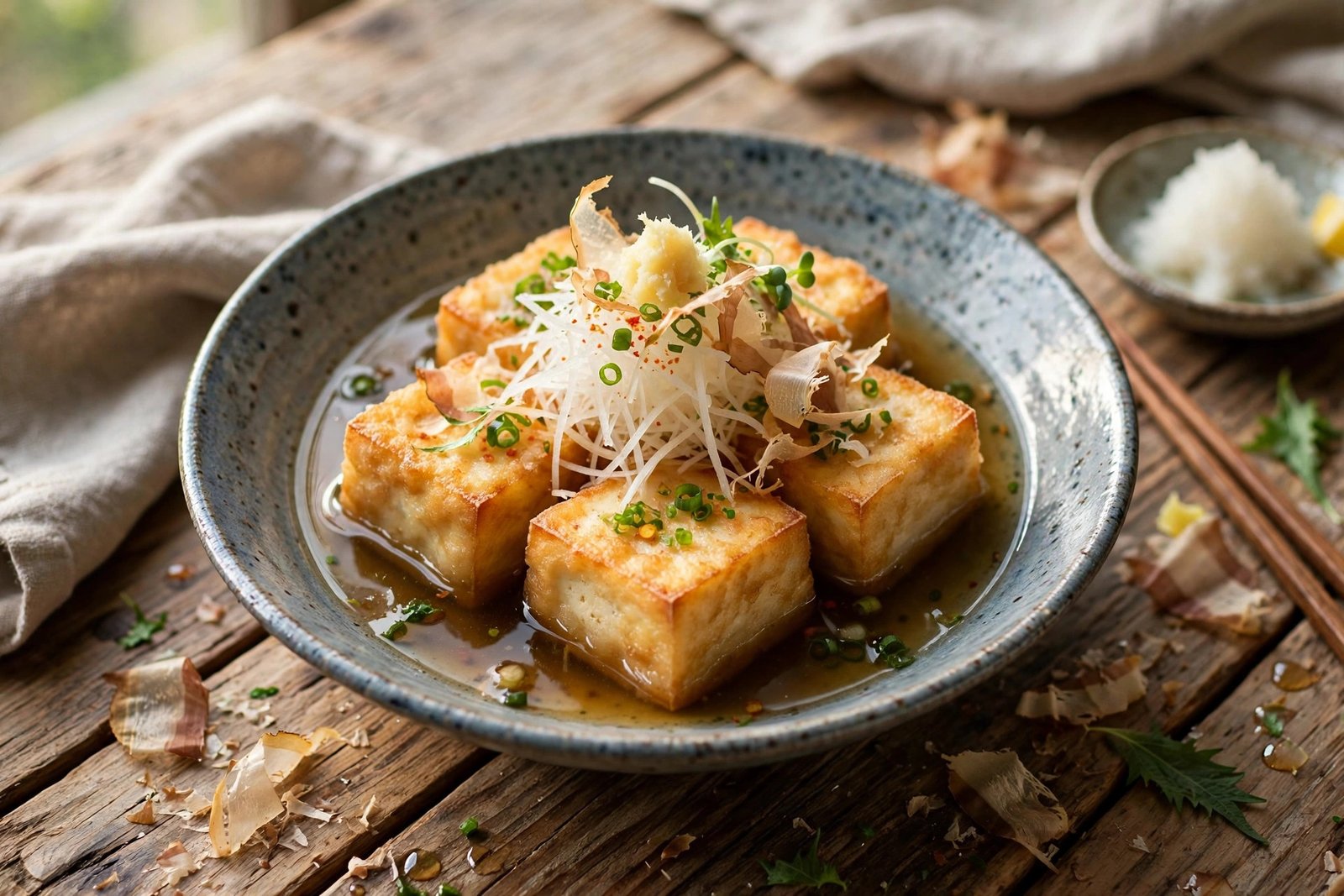
Cubes of tofu fry to a delicate golden crust, then soak briefly in a warm dashi broth scented with ginger. The contrast of crisp outside and custardy inside is pure comfort. A light, elegant start to any Japanese meal, and a dish that proves how much flavour a simple block of tofu can hold.
The story behind Agedashi Tofu
Agedashi tofu is one of Japan's most elegant dishes, and it is also one of the simplest. Agedashi means fried and soaked — cubes of tofu, fried until golden, then set in a warm dashi broth. It is a dish of contrasts: crisp outside and custardy inside, hot tofu and warm broth, rich frying and clean, clear stock. And it is a dish that proves how much flavour a simple block of tofu can hold.
The tofu is the star, and it must be treated with care. It is pressed to remove water, coated in a whisper of potato starch, and fried until the outside turns golden and crisp. Inside, the tofu stays soft and creamy, almost custardy — a texture that no other ingredient can match. The contrast between the crisp shell and the soft centre is the whole point of the dish.
The broth is the partner. Dashi, soy sauce and mirin, simmered briefly, give a warm, savoury liquid that the tofu soaks up from below. The broth is ladled around the tofu, never over it, so the crust stays crisp on top while the bottom softens gently. The grated daikon and ginger on top add freshness and warmth, and the spring onions add colour.
Agedashi tofu is a starter, a light meal, a quiet dish for a quiet evening. It is served in small bowls, eaten with chopsticks and a spoon, and it is at its best in the first few minutes — while the crust is still crisp and the broth is still steaming. It is a dish that rewards attention and punishes delay.
Make it when you want something light and elegant, or when you have good tofu and a little time. It takes 30 minutes, it feeds four, and it is the kind of dish that makes a simple meal feel like a proper Japanese dinner.
Agedashi tofu is also a dish that teaches the value of restraint. The tofu is coated in a whisper of starch, not a thick batter. The broth is ladled around the cubes, not poured over them. The garnishes are a pinch here, a grating there — small amounts, precisely placed. It is a dish that shows how little is needed when the ingredients are good and the technique is right, and it is a lesson in doing less, better.
- Prep time
- 15 mins
- Cook time
- 15 mins
- Total time
- 30 mins
- Servings
- 4 servings
- Calories
- 290
Ingredients
- 400g firm or medium-firm tofu
- 60g potato starch (or cornflour), for coating
- 500ml neutral oil, for deep frying
- 400ml dashi stock
- 3 tablespoons soy sauce
- 2 tablespoons mirin
- 100g daikon radish, finely grated
- 2cm piece fresh ginger, finely grated
- 2 spring onions, thinly sliced
- 1 teaspoon toasted sesame seeds (optional)
- Shichimi togarashi, to serve (optional)
Instructions
- Wrap the tofu block in clean tea towels and press it gently for 10 minutes, with a plate and a light weight on top, to remove excess water. Then cut it into 8 equal cubes and pat each one very dry with paper towels. The drier the tofu before coating, the crisper the crust — do not rush the pressing and patting.
- Heat the oil in a deep pan to 175°C. Test the temperature with a cube of bread — it should sizzle at once and turn golden in about 30 seconds. If the bread browns in seconds, the oil is too hot; if it sits pale, the oil is too cool. The right temperature is what makes the crust crisp instead of greasy.
- Dust each tofu cube evenly in the potato starch, turning it to coat every side, then shake off every bit of excess. The coating must be whisper-thin — a thick coat turns gummy in the oil, while a thin one fries up into a delicate, golden shell. Set the coated cubes on a plate in a single layer.
- Fry the tofu in two batches for 3 to 4 minutes per batch, until deeply golden and crisp all over. Turn the cubes gently with a slotted spoon so every side meets the hot oil. Lift them out and drain briefly on a wire rack — not paper towels, which trap steam and soften the crust.
- While the tofu fries, simmer the dashi stock, soy sauce and mirin together in a small saucepan for 3 minutes, until the flavours marry and the broth smells fragrant. The broth should be warm and savoury, with a gentle sweetness from the mirin — taste it and adjust with a little more soy or mirin.
- Divide the hot tofu cubes among four shallow bowls, arranging two cubes in each. Ladle the steaming broth around the cubes — not over them — so the crust stays crisp. The broth should pool around the base of the tofu, not drown it, and the tops should stay dry and golden.
- Top each serving with a little grated daikon, grated ginger, sliced spring onions and a sprinkle of toasted sesame seeds. The daikon adds a fresh, peppery bite, the ginger adds warmth, and the spring onions add colour and crunch.
- Serve immediately, with shichimi togarashi on the side for those who want heat. Agedashi waits for no one — the crust is at its crispiest in the first few minutes, and the broth softens it steadily from the moment it is ladled in.
Pro tips
- The drier the tofu before coating, the crisper the crust — do not rush the pressing and patting, they are the foundation of the dish.
- Fry in batches; overcrowding drops the oil temperature and gives soggy tofu instead of crisp, golden cubes.
- Ladle the broth around the tofu, never over it, to protect that delicate crunch. The tops must stay dry and golden.
- Eat it the moment it hits the table — agedashi waits for no one, and the crust softens steadily from the moment the broth is ladled in.
- Shake off every bit of excess starch before frying. A thick coat turns gummy, while a whisper-thin one fries into a delicate shell.
Variations & serving ideas
The tofu can change with the season. Silken tofu, handled very gently, makes a softer, more delicate version — though it falls apart easily, so save it for when you are confident. Smoked tofu adds a savoury depth that suits the dashi broth. And for a heartier version, use extra-firm tofu and cut the cubes larger.
The broth can flex too. A little grated ginger, simmered in the dashi, adds warmth. A splash of sake gives depth. A pinch of sugar, alongside the mirin, makes a sweeter broth that suits a richer tofu. And for a spicier version, add a pinch of shichimi togarashi to the broth itself, not just on the side.
The toppings are easy to change. A little grated yuzu zest adds a citrusy brightness. A few leaves of shiso, torn over the top, add a fresh, herbal note. A sprinkle of chili threads gives colour and gentle heat. And a soft-boiled egg, halved and laid beside the tofu, turns the starter into a light meal.
Serve agedashi tofu as a starter before a Japanese meal, or as a light lunch with rice and pickled vegetables. It pairs with green tea, cold sake, or a sparkling water. A shallow bowl, a pair of chopsticks, and a quiet moment — that is all it takes.
A few practical notes help the dish turn out well every time. If the oil is too cool, the tofu absorbs it and turns greasy; if it is too hot, the crust burns before the inside warms through. A thermometer takes the guesswork out, but the bread-cube test works well too. And if you are serving agedashi to guests, fry the tofu in batches and keep the finished cubes warm in a low oven while you fry the rest — they hold their crispness for a few minutes.
Getting it right
The key technique is the drying. The tofu must be pressed for 10 minutes, cut into cubes, and patted very dry — every drop of water left on the surface turns to steam in the hot oil and softens the crust from within. The drier the tofu, the crisper the crust. Do not rush the pressing and the patting; they are the foundation of the whole dish.
The coating is the second skill. The potato starch must be dusted evenly over every side, then shaken off completely, so the coating is whisper-thin. A thick coat turns gummy and heavy in the oil, while a thin one fries into a delicate, golden shell. Less is more — the starch should be barely visible on the tofu before it goes into the oil.
The frying is the third skill. The oil must be at 175°C, and the tofu must be fried in two batches — overcrowding drops the temperature and gives soggy tofu. Three to 4 minutes per batch is enough, until the cubes are deeply golden and crisp. Drain on a wire rack, not paper towels, so the steam escapes and the crust stays crisp.
The common mistakes are wet tofu, a thick coat, and broth poured over the top. Dry the tofu thoroughly. Shake off the excess starch. And ladle the broth around the cubes, never over them — the tops must stay dry and golden, while the bottoms soak gently in the broth.
One last detail: serve the tofu the moment it is dressed, while the crust is still crisp and the broth is still steaming. Agedashi waits for no one — the crust softens steadily from the moment the broth is ladled in, and the first few minutes are when the dish is at its best.
Storing & reheating
Agedashi tofu is best eaten the moment it is made, while the crust is still crisp and the inside is still custardy. It does not keep — the broth softens the crust within minutes, and reheating turns the tofu rubbery. If you must keep it, store the fried tofu and the broth separately in the fridge for up to a day.
Reheat the tofu in a hot oven at 200°C for 5 minutes to bring back some of the crispness, and warm the broth gently in a saucepan. Ladle the broth around the tofu just before serving, as before. The dish will never be as good as fresh, but it is still worth eating. Agedashi tofu does not freeze well.
For the best flavour, make the broth fresh each time. Dashi loses its fragrance on standing, and a freshly simmered broth tastes brighter and cleaner than one reheated from the fridge.
Frequently asked questions
What kind of tofu is best for agedashi?
Firm or medium-firm tofu holds its shape best. Silken tofu is traditional in some regions but falls apart easily, so save it for when you are confident with the frying and the handling.
What is dashi?
Dashi is Japanese soup stock, usually made from kombu seaweed and bonito flakes. Instant dashi granules dissolved in hot water work perfectly here, and they are what most home cooks use.
Can I make agedashi tofu gluten-free?
Yes — use tamari instead of soy sauce and check that your dashi granules are gluten-free. Potato starch is naturally gluten-free, so the coating needs no change.
Can I air-fry the tofu instead of deep frying?
You can, though the crust will be less delicate. Spray the coated cubes with oil and air-fry at 200°C for 12 to 15 minutes, turning halfway. The crust will be crisp but thicker than the deep-fried version.
Why is my tofu soggy instead of crisp?
The tofu was probably not dry enough before coating, or the oil was not hot enough. Press and pat the tofu thoroughly, and make sure the oil is at 175°C before the first cube goes in.
Can I make agedashi tofu vegan?
Yes — use a kombu-only dashi, made from seaweed with no bonito flakes, and check that your soy sauce is vegan. The dish is naturally plant-based apart from the dashi.