Mango Lassi Recipe
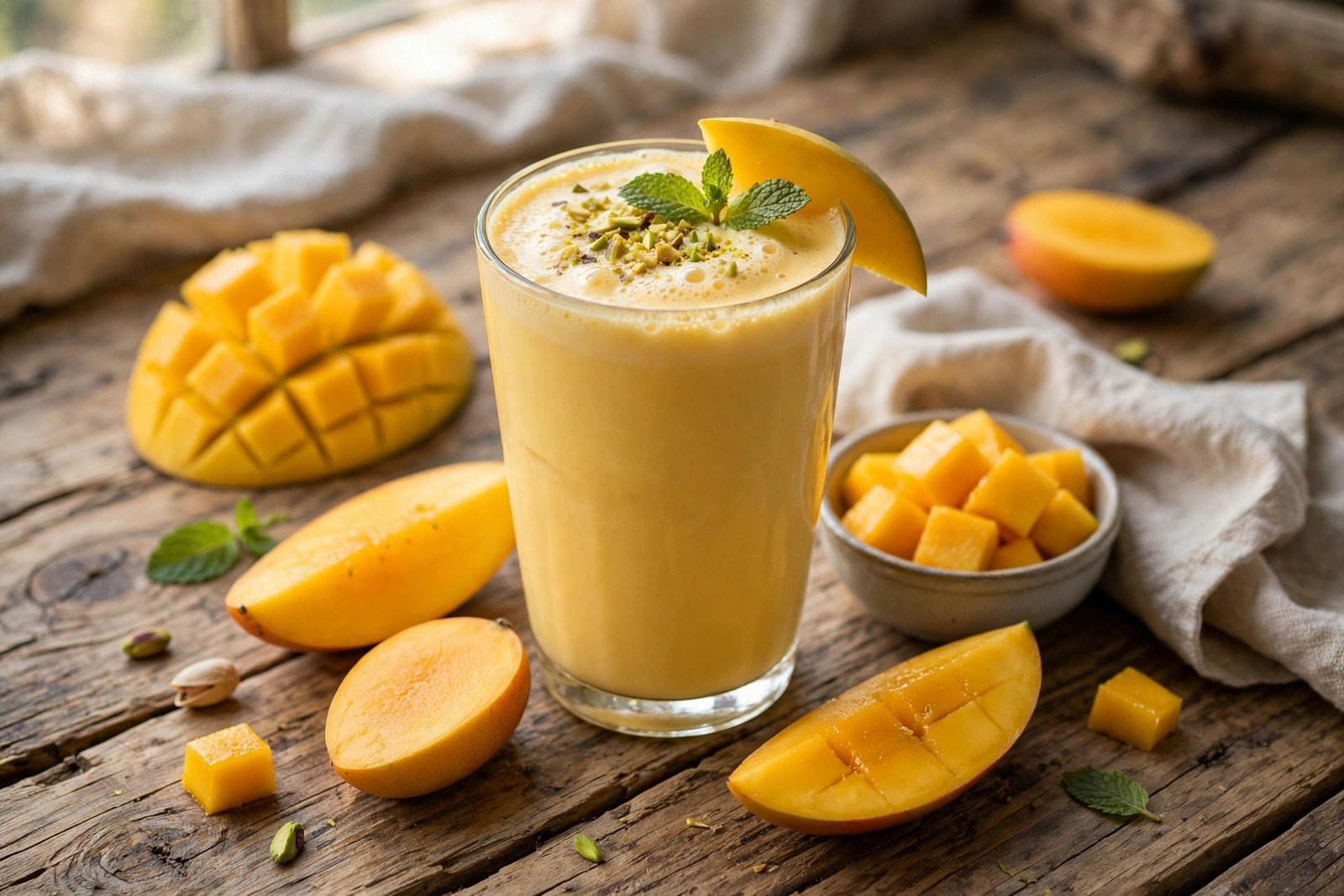
Mango lassi is the crown jewel of Indian summer drinks — ripe mangoes whisked with creamy yogurt, a whisper of cardamom, and just enough sugar. Thick, fragrant, and ice-cold, it doubles as dessert and refreshment in one tall glass, topped with pistachios and saffron.
The story behind Mango Lassi
Lassi is one of India's oldest drinks, made from yogurt churned with water, and mango lassi is its most beloved variation. When mangoes are in season — the hot, heavy months of May and June — mango lassi appears everywhere: in homes, in restaurants, at street stalls, in tall glasses frosted with cold. It is dessert and refreshment in one, and it is the drink that makes an Indian summer bearable.
The mango matters more than anything else in this drink. Alphonso mangoes, from the Konkan coast of Maharashtra, are the gold standard — intensely sweet, fragrant, and almost entirely free of fibre. But any ripe, sweet mango works. The mango should be soft, fragrant, and sweet enough to eat on its own. An underripe mango makes a sour, fibrous lassi that no amount of sugar can fix.
The yogurt is the second half of the drink. Plain, whole-milk yogurt gives the lassi its creamy body and its gentle tang, which balances the sweetness of the mango. Low-fat yogurt makes a thinner, sharper lassi. The best lassi uses thick, creamy yogurt — the kind that holds its shape on a spoon — and just enough milk to make it pourable.
Mango lassi takes 10 minutes, most of it peeling mangoes. It is the kind of drink you make on a hot afternoon, when the mangoes are ripe and the ice is cold, and you want something that tastes like summer. Serve it in tall glasses, garnished with pistachios, and drink it slowly — or all at once, which is what usually happens.
- Prep time
- 10 mins
- Cook time
- 0 mins
- Total time
- 10 mins
- Servings
- 4 glasses
- Calories
- 210
Ingredients
- 2 large ripe mangoes (about 500 g flesh), or 400 g mango pulp
- 250 g plain whole-milk yogurt
- 120 ml cold milk
- 3 tablespoons granulated sugar, or to taste
- 1/4 teaspoon ground cardamom
- 8 ice cubes
- 2 tablespoons chopped pistachios, for garnish
- A pinch of saffron threads (optional)
Instructions
- Choose ripe mangoes. They should give slightly when pressed, smell fragrant at the stem end, and feel heavy for their size. Peel the mangoes, cut the flesh away from the flat pit, and cube it. You need about 500 g of flesh — roughly 2 large mangoes. If you are using mango pulp, measure out 400 g.
- Add the mango flesh to a blender, along with the yogurt, cold milk, sugar, ground cardamom, and saffron threads if using. The saffron adds colour and a gentle floral note, but it is optional — the lassi is wonderful without it. Start with 3 tablespoons of sugar; you can add more later.
- Blend on high for 60 seconds, until completely smooth and frothy. The mixture should be thick, creamy, and uniform, with no chunks of mango left. Stop and scrape down the sides halfway through if needed. The blending also whips a little air into the lassi, making it light and frothy.
- Add the ice cubes and blend for 20 seconds more, until thick and frosty. The ice chills the lassi and thickens it further. Do not blend too long after adding the ice, or the friction warms the drink and melts the ice. Twenty seconds is enough — the lassi should be cold and thick.
- Taste the lassi and adjust. If the mangoes were very sweet, you may not need more sugar. If they were tart, add a tablespoon more sugar and blend briefly. The lassi should taste sweet and mango-forward, with a gentle tang from the yogurt and a whisper of cardamom in the background.
- Pour into tall glasses, dividing it evenly. The lassi should be thick enough to pour slowly, in a rich, creamy stream. If it is too thick to pour, add a splash of cold milk and stir. If it is too thin, blend in a few more ice cubes.
- Garnish each glass with chopped pistachios and a pinch of saffron threads if you like. The pistachios add colour and a little crunch, and they make the drink look as good as it tastes. Serve immediately with a straw — or a spoon, for the thickest lassis — and drink it cold.
Pro tips
- Use ripe, fragrant mangoes. The mango is the whole drink — an underripe mango makes a sour, fibrous lassi that sugar cannot fix. The mango should smell sweet at the stem, give slightly when pressed, and feel heavy. Alphonso mangoes are the best, but any ripe, sweet variety works.
- Use whole-milk yogurt, not low-fat. Full-fat yogurt gives the lassi its creamy body and balances the sweetness of the mango. Low-fat yogurt makes a thin, sharp drink. Thick, creamy yogurt — the kind that holds its shape — is ideal.
- Blend the mango and yogurt first, then add the ice. Blending the ice with everything from the start melts it before the mango is smooth, giving a thin, watery lassi. Blend the base smooth first, then add ice for 20 seconds to chill and thicken it.
- Taste before adding more sugar. Mangoes vary enormously in sweetness, and a very ripe mango may need no extra sugar at all. Start with 3 tablespoons, blend, taste, and add more only if needed. The lassi should taste of mango first, sweetness second.
- Serve immediately, ice-cold. Mango lassi separates if it sits — the mango and yogurt settle and the ice melts. Blend it, pour it, and drink it straight away. If you must make it ahead, blend without ice and refrigerate, then add ice and re-blend just before serving.
Variations & serving ideas
A plain sweet lassi is the original — yogurt, milk, sugar, and a pinch of cardamom, blended until frothy, with no fruit at all. It is simpler and lighter than mango lassi, and it is the drink that accompanies spicy food across northern India. A dollop of clotted cream, or malai, on top is the traditional finish.
For a salted lassi, skip the sugar and mango entirely and blend yogurt with cold water, a pinch of salt, and a little roasted cumin powder. The result is savoury, refreshing, and deeply cooling — the drink of choice on the hottest days. A few mint leaves blended in add freshness.
Strawberry lassi uses ripe strawberries in place of mango, with a squeeze of lemon to brighten the flavour. The colour is beautiful — pale pink and creamy — and the taste is fresh and summery. Any soft fruit works the same way: banana, peach, or a handful of berries.
For a richer, dessert-style lassi, add a scoop of vanilla ice cream to the blender along with the mango and yogurt. The ice cream makes the lassi thicker, creamier, and more indulgent — closer to a milkshake than a drink. Top with extra pistachios and a drizzle of honey.
A vegan mango lassi uses coconut yogurt and oat milk in place of dairy yogurt and milk. The coconut adds a tropical note that pairs beautifully with the mango, and the result is just as thick and creamy. Use a thick coconut yogurt for the best texture.
For a spiced mango lassi, add a pinch of ground ginger and a tiny pinch of black salt along with the cardamom. The ginger adds warmth and the black salt — kala namak — adds a subtle savoury note that makes the mango taste even sweeter by contrast. It is an unusual combination, but it is a traditional one in parts of northern India, where lassis are seasoned as boldly as any other dish.
Getting it right
The technique that defines mango lassi is the blending order. Mango, yogurt, milk, sugar, and cardamom go in first and blend for a full 60 seconds until completely smooth and frothy. The ice goes in last, for just 20 seconds — long enough to chill and thicken the drink, short enough that the friction does not melt it. Blending everything together from the start gives a thin, watery lassi; blending in stages gives a thick, frosty one.
The ratio matters too. Two parts mango to one part yogurt, with just enough milk to make it pourable, gives a lassi that is thick and mango-forward without being heavy. Too much milk thins it; too much yogurt makes it sour. The sugar is the variable — start with 3 tablespoons and adjust to your mangoes, because no two mangoes are equally sweet.
The most common mistake is using underripe mango, which gives a sour, fibrous drink. The mango should be soft, fragrant, and sweet enough to eat on its own. The second mistake is over-blending after adding the ice, which melts it and thins the lassi. Twenty seconds is enough. If your lassi is too thin, add more mango or more ice; if it is too thick, add a splash of cold milk.
The blender itself matters. A high-powered blender turns mango and yogurt into a perfectly smooth, frothy drink in 60 seconds. A weaker blender may leave small chunks of mango, especially if the fruit is fibrous. If your blender struggles, cut the mango smaller, blend for a little longer, and stop to scrape down the sides. Straining the finished lassi through a fine sieve is a last resort that guarantees smoothness, though it removes some of the fibre.
Storing & reheating
Mango lassi is best drunk immediately, ice-cold, straight from the blender. It separates if it sits — the mango and yogurt settle and the ice melts. If you must store it, refrigerate without ice for up to 1 day in a sealed container, then stir well and add fresh ice before serving.
Do not freeze mango lassi — the yogurt separates when thawed and the texture turns grainy. The mango pulp, however, freezes well for months; thaw it and blend a fresh lassi in minutes. Keep frozen mango pulp on hand and mango lassi is always 10 minutes away.
Frequently asked questions
What mangoes are best for mango lassi?
Alphonso mangoes are the gold standard — intensely sweet, fragrant, and almost fibre-free. But any ripe, sweet mango works well. The mango should be soft, fragrant at the stem, and sweet enough to eat on its own. Avoid underripe or fibrous mangoes, which make a sour, stringy lassi. Canned mango pulp is a good year-round substitute.
Can I use frozen mango?
Yes, and it works very well — frozen mango blends into a thick, frosty lassi and you may not need to add ice. Use about 400 g of frozen mango chunks and blend with the yogurt and milk as normal. The lassi will be extra thick and cold. Let the mango thaw for 5 minutes first so the blender can handle it.
Why is my lassi too thin?
Too much milk, too much ice, or low-fat yogurt. Use whole-milk yogurt, add just enough milk to make the lassi pourable, and blend the ice for only 20 seconds so it does not melt. If the lassi is still thin, add more mango or a few more ice cubes and blend briefly.
Can I make mango lassi without sugar?
Yes, if your mangoes are very ripe and sweet. Taste the lassi before adding sugar — ripe Alphonso mangoes often need none at all. Honey is a good alternative sweetener, adding a floral note that pairs well with the mango. Start with a tablespoon and adjust to taste.
Is mango lassi healthy?
It is a nutritious drink — mango provides vitamins A and C, and yogurt provides protein, calcium, and probiotics. The sugar adds calories, so use as little as your mangoes need. With ripe, sweet mangoes and no added sugar, mango lassi is a genuinely wholesome drink. Full-fat yogurt makes it richer; low-fat makes it lighter.
Can I make lassi ahead of time?
Blend the mango, yogurt, milk, sugar, and cardamom and refrigerate for up to 1 day, without the ice. The lassi will separate slightly — stir it well before serving, add fresh ice, and blend briefly to re-chill and froth it. Do not store lassi with ice in it, or it will be watery by the time you serve it.