Boeuf Bourguignon Recipe
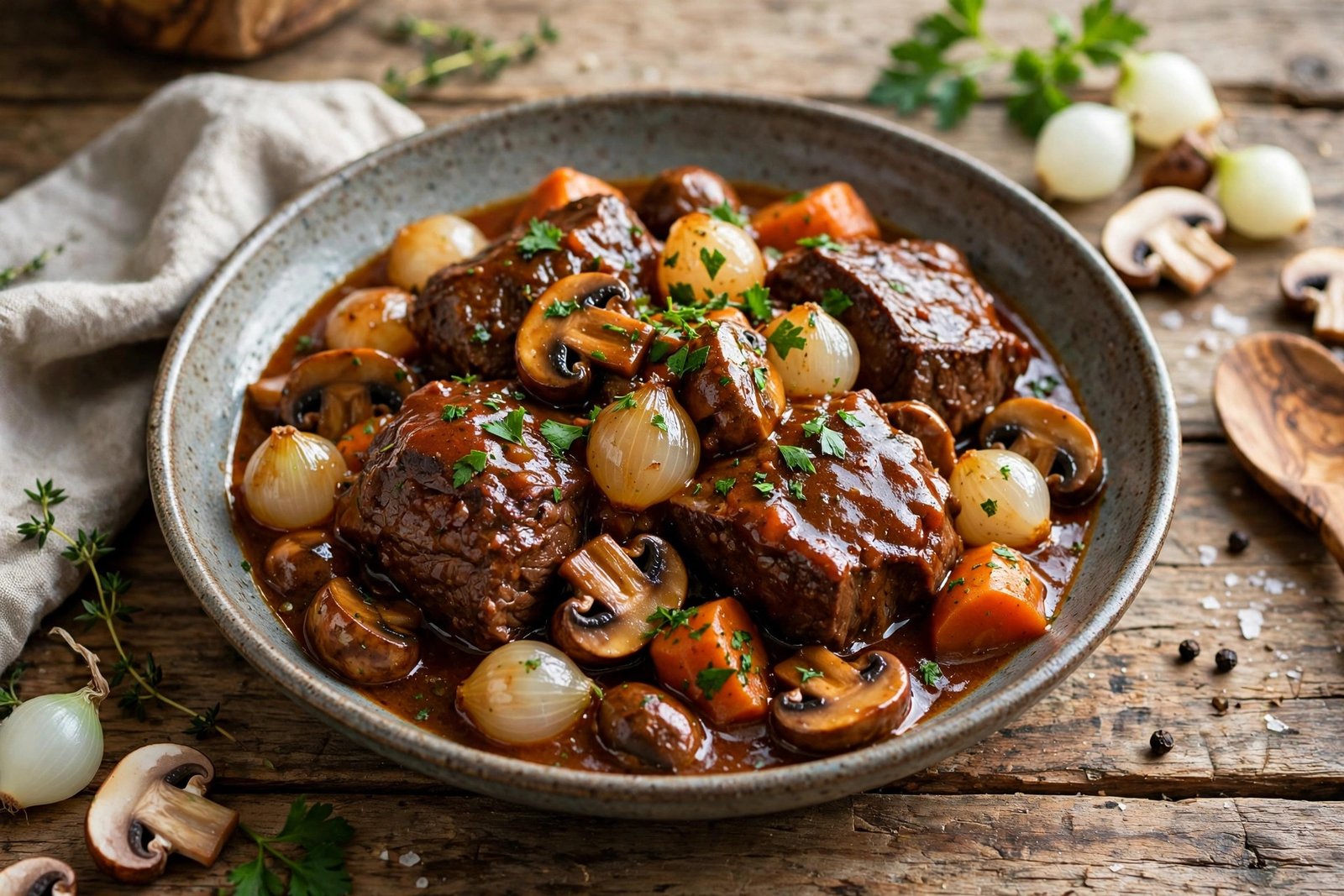
Boeuf bourguignon is France's most famous stew: beef braised slowly in red wine until it surrenders at the touch of a fork, with smoky bacon, mushrooms and sweet pearl onions in a sauce so dark and glossy it looks almost black. It takes an afternoon, most of it hands-off, and the reward is a dish that tastes like a special occasion. Serve it with buttery mash and you have the kind of dinner people remember.
The story behind Boeuf Bourguignon
Boeuf bourguignon comes from Burgundy, in eastern France, where the local Charolais cattle and the region's red wine have shaped the cooking for centuries. It began as a peasant dish — a way to turn tough, cheap cuts of beef into something worth eating by braising them slowly in wine until the fibres gave up and the sauce turned rich and dark. The recipe was written down in the nineteenth century, but it was Julia Child who carried it to the wider world: her boeuf bourguignon, published in Mastering the Art of French Cooking in 1961, became the dish that taught a generation of home cooks that French food was something they could actually make.
What sets it apart from an ordinary beef stew is the wine and the patience. The beef simmers for hours in a full bottle of red, with the stock, tomato paste and a bouquet garni, until it is so tender it falls apart under a fork. The mushrooms and pearl onions are cooked separately and stirred in at the end, so they keep their shape and colour instead of dissolving into the sauce. The result is a stew with layers: the deep, almost chocolatey sauce, the smoky bacon, the sweet onions, the earthy mushrooms — each one still distinct. That separation is the small piece of craft that makes the dish taste like a restaurant version rather than a brown stew.
In France it is a dish for Sundays and celebrations, the kind of thing that simmers away while the family gathers. It is also famously better the next day, which makes it a cook's friend: make it on Saturday, let it rest overnight in the fridge, and reheat it gently on Sunday while you mash the potatoes. The flavours settle and deepen, and the fat rises to the top where it can be lifted off easily — a neater sauce for no extra work.
This recipe asks for about three hours in the oven, but almost all of it is hands-off. Twenty-five minutes of prep and browning, then the pot does the work while you get on with your day. It serves four generously, and it scales well — double it for a dinner party and let the oven do the work while you set the table. A bottle of the same wine you cooked with, opened to breathe while the stew rests, is the only finishing touch it needs.
- Prep time
- 25 mins
- Cook time
- 180 mins
- Total time
- 205 mins
- Servings
- 4 servings
- Calories
- 560
Ingredients
- 1 kg beef chuck, cut into large chunks
- 150 g smoked bacon lardons
- 750 ml full-bodied red wine
- 2 onions, chopped, and 2 carrots, sliced
- 3 garlic cloves, minced
- 2 tablespoons tomato paste
- 500 ml beef stock
- 2 tablespoons flour
- 3 tablespoons olive oil
- 200 g button mushrooms, halved
- 12 pearl onions, peeled
- 1 bouquet garni (thyme, bay, parsley)
- Salt and black pepper, to taste
- Mashed potatoes or crusty bread, to serve
Instructions
- Cut the beef into large chunks, about 5 cm across, and pat them very dry with kitchen paper — wet beef steams instead of browning. Season generously with salt and pepper. Heat a tablespoon of the olive oil in a large flameproof casserole over a medium-high heat and fry the lardons for 4 to 5 minutes, until crisp and golden. Lift them out with a slotted spoon and set aside, leaving the fat in the pot.
- Brown the beef in batches in the bacon fat, adding a little more oil if the pot looks dry. Do not crowd the pan: the chunks need space to colour, and you want deep brown crusts on at least two sides. This takes 3 to 4 minutes per batch. Set the browned beef aside with the lardons.
- Turn the heat down to medium and add the chopped onions and sliced carrots. Cook for about 5 minutes, stirring and scraping the bottom, until the onion softens and starts to colour. Stir in the garlic and tomato paste and cook for 1 minute, until the paste darkens and smells sweet rather than raw.
- Sprinkle the flour over the vegetables and stir for a minute so it coats everything and loses its raw taste. Then pour in the red wine, a little at a time, scraping the base of the pot to lift up all the browned bits — those are the foundation of the sauce. Let the wine bubble for 2 minutes to cook off the harsh alcohol edge.
- Return the beef and lardons to the pot and pour in the beef stock. Tuck in the bouquet garni and season with salt and pepper. The liquid should just about cover the meat; add a splash of water if it falls short. Bring the pot to a gentle simmer on the hob.
- Cover with a tight-fitting lid and slide the casserole into a 160°C oven. Cook for 2 hours 30 minutes, until the beef is very tender and yields easily when pressed with a fork. Give it a stir halfway through if you remember — but do not fuss over it. The oven's even heat does the work.
- While the stew cooks, fry the mushrooms and pearl onions. Heat the remaining olive oil in a frying pan over a medium-high heat, add the mushrooms cut side down, and leave them alone for 3 minutes until golden underneath. Add the pearl onions and cook for another 5 minutes, shaking the pan, until everything is browned at the edges. Season lightly and set aside.
- Lift the casserole from the oven and check the sauce: it should be glossy and thick enough to coat a spoon. If it is thin, simmer it on the hob for 10 minutes with the lid off. Stir in the mushrooms and pearl onions, fish out the bouquet garni, and taste for seasoning — a little more salt, maybe a crack of pepper.
- Let the stew rest for 10 minutes, then serve in wide, shallow bowls with buttery mashed potatoes or crusty bread to catch the sauce. A scattering of chopped parsley over the top is the only garnish it needs.
Pro tips
- Brown the beef properly and in batches. Those dark, caramelised edges are the flavour of the whole dish — grey, steamed beef makes a grey, flat sauce, and no amount of wine will rescue it.
- Use a wine you would happily drink. The alcohol cooks off but the character stays, so a thin, sour wine gives a thin, sour sauce. A decent Côtes du Rhône or Pinot Noir is perfect; it does not need to be expensive.
- Cook the mushrooms and onions separately. Stirred in from the start, they turn grey and limp after three hours; fried golden and added at the end, they keep their texture, their colour, and their own flavour in the finished dish.
- Make it a day ahead when you can. An overnight rest in the fridge deepens the sauce and lets the fat set on top, where you can lift it off in one piece before reheating. The stew reheats beautifully and tastes better for the wait.
- Keep the oven low and slow. A hard boil toughens the meat and clouds the sauce; 160°C with the lid on gives a gentle, even braise. If your oven runs hot, drop to 150°C and add 20 minutes.
Variations & serving ideas
The classic cut is beef chuck, but shin works beautifully too — it has more connective tissue, which melts into the sauce and gives it extra body. Short ribs are a richer option for a special occasion, though they need an extra half hour. Whatever the cut, keep the pieces large: small cubes dry out over a three-hour braise, while big chunks stay juicy inside. Ask the butcher to cut it for stewing, and do not trim away all the fat — a little marbling keeps the meat moist through the long cook.
For a lighter, spring version, swap half the mushrooms for baby carrots and add a handful of peas in the last 10 minutes. A few strips of orange zest tucked in with the bouquet garni brighten the sauce in a way that suits warmer weather. In autumn, wild mushrooms — porcini, chanterelles — in place of button mushrooms make the dish taste like the season. A splash of brandy flambéed with the wine is a classic bistro touch; it adds warmth and a faint sweetness, though the dish is complete without it.
The traditional accompaniments are buttery mashed potatoes, buttered egg noodles, or a pile of crusty bread. Mashed celeriac or parsnip mash are good alternatives that stand up to the rich sauce. A simple green salad with a sharp mustard dressing, served after the stew in the French way, cuts through the richness and resets the palate. Whatever you serve, make sure there is something to catch the sauce — bread for mopping is not optional, it is half the point of the dish.
Leftovers are a gift. Shredded beef and sauce spooned over fresh pasta makes a quick ragu; folded into a pie with a puff pastry lid it becomes a second dinner entirely. The sauce alone, strained, is a superb base for a mushroom risotto. Nothing from this pot should ever go to waste. If you have a lot left over, freeze the beef and sauce in portions; it keeps for three months and thaws into a dinner that tastes as though you spent the afternoon on it.
Getting it right
Browning is the technique that makes or breaks this stew. The beef must be dry, the pot hot, and the pieces given space — crowd them and they steam, releasing their juices into a grey puddle. Work in batches, let each piece sit until it releases from the pan with a dark crust, and do not rush it. The same applies to the mushrooms later: leave them cut side down and untouched until they are golden underneath, or they will just sweat.
The braise itself is about low, even heat. An oven at 160°C surrounds the pot with steady warmth, which is why it beats a hob for long cooking — no hot spot at the bottom, no need to stir. The liquid should barely tremble, never boil hard. If the sauce is reducing too fast, the lid is not tight enough; lay a sheet of foil under it to seal the pot properly.
The most common mistake is impatience. Beef chuck needs the full two and a half hours to turn tender; pulling it at two leaves it chewy, and no amount of sauce hides that. If the meat is still firm after the stated time, give it another 30 minutes — braised beef forgives extra time far more easily than too little. The second mistake is a thin sauce: if it looks watery at the end, simmer it uncovered on the hob for 10 minutes, or stir in a knob of butter mixed with a teaspoon of flour to bring it together.
Storing & reheating
Boeuf bourguignon keeps for 3 days in the fridge in a sealed container, and it genuinely improves overnight — the sauce deepens and the fat rises to the surface, where it can be lifted off before reheating. It also freezes well for up to 3 months; portion it into tubs or freezer bags and label with the date. Thaw overnight in the fridge.
Reheat gently in a covered saucepan over a low heat for 15 to 20 minutes, stirring occasionally, until it is bubbling all the way through. Add a splash of stock or water if the sauce has thickened too much in the fridge. Avoid the microwave for the whole pot — it heats unevenly and can toughen the beef — though a single portion reheats fine in short bursts.
Frequently asked questions
What wine should I use?
A full-bodied red Burgundy is traditional, but any good Côtes du Rhône or Pinot Noir works well. The one rule is to cook with a wine you would happily drink — the alcohol cooks away but the flavour stays. Avoid anything labelled cooking wine, which is usually salty and thin.
Can I cook boeuf bourguignon on the stove?
Yes. Simmer it gently on the lowest heat for the same 2 hours 30 minutes, with the lid on, stirring every 30 minutes so nothing catches on the bottom. A heat diffuser helps if your hob runs hot. The oven gives a more even result, but the stove works fine.
What is served with boeuf bourguignon?
Buttery mashed potatoes are the classic partner, with buttered noodles or crusty bread close behind. The sauce is the star, so whatever you choose should be able to catch it — bread for mopping is almost part of the recipe.
How long does it keep?
Three days in the fridge, and it tastes better on day two. It freezes well for up to 3 months in portions. Thaw overnight in the fridge and reheat gently on the hob, adding a splash of stock if the sauce needs loosening.
Can I make it in a slow cooker?
Yes, with one change: brown the beef, lardons and vegetables on the hob first, then transfer everything to the slow cooker. Cook on low for 7 to 8 hours. Fry the mushrooms and pearl onions separately and stir them in at the end, as usual.
Why is my sauce thin?
The lid may have been loose, or the oven a little cool, so the sauce never reduced. Simmer it uncovered on the hob for 10 to 15 minutes at the end, which thickens it naturally. A knob of butter mashed with a teaspoon of flour, stirred in and simmered for 2 minutes, will finish the job.