Beef Bihari Kabab Recipe
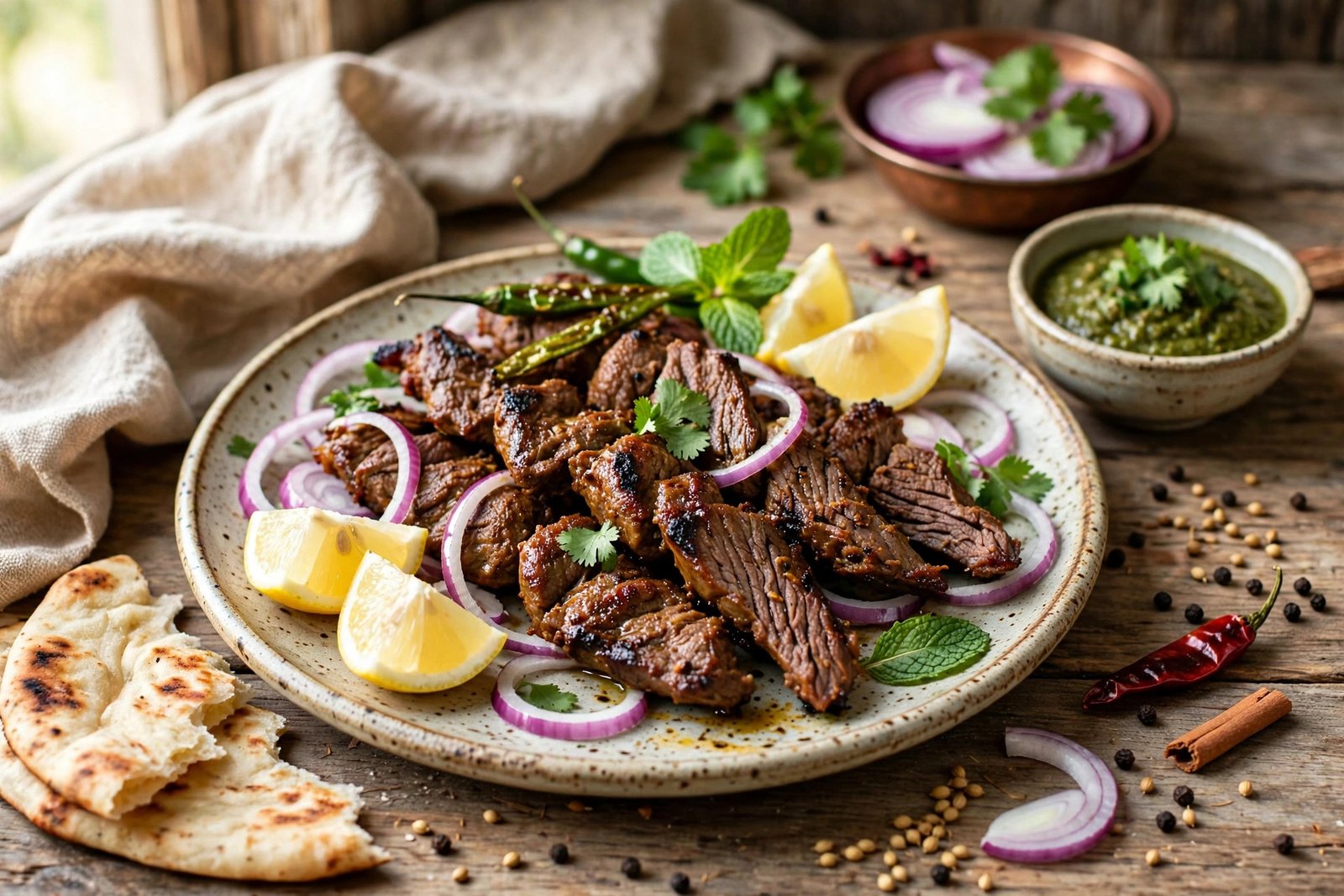
Thin strips of beef marinated in raw papaya and spices, grilled until smoky, beef bihari kabab is a desi barbecue legend. Best eaten hot off the coals with paratha, raita, and sliced onions — and made for sharing, though nobody wants to share.
The story behind Beef Bihari Kabab
Bihari kabab comes from Bihar, the state in eastern India whose Muslim cuisine is one of the great kebab traditions of the subcontinent. The dish travelled with migration — to Lucknow, to Delhi, to Karachi and Lahore — and it became a fixture of desi barbecue culture, the dish that experienced grillers make to show off. The secret is raw papaya, whose enzyme, papain, tenderises meat in a way that no amount of beating or slow cooking can match.
What makes it special is the combination of tenderness and smoke. The beef is sliced thinly, against the grain, marinated in papaya and mustard oil and spices, and grilled fast over hot charcoal until the edges char. The result is meat that is soft enough to cut with a fork, smoky from the coals, and fragrant with cumin, coriander and garam masala. The mustard oil adds a pungent warmth that is unmistakably desi — no other oil tastes like it.
In Pakistan and India, bihari kabab is barbecue food, eaten at Eid gatherings, at family barbecues, and at street stalls where the grill is always going. It is served with paratha, raita, and sliced onions, and it is eaten with the hands, the kabab torn and wrapped in the paratha with a spoonful of raita. It is the kind of food that brings people to the grill, standing around and eating straight off the skewer.
The marinade is a small piece of food science. Raw papaya contains papain, an enzyme that breaks down the proteins in meat, and it works fast — two hours is enough, and twelve hours is the limit, after which the meat turns mushy. The yoghurt adds tang and helps the spices cling, the mustard oil adds flavour and keeps the meat moist, and the lemon juice brightens everything. It is a marinade that has been refined over generations, and every ingredient earns its place.
This recipe serves four and takes about thirty minutes of preparation plus at least two hours of marinating, then twenty minutes of grilling. It needs raw papaya paste, mustard oil, and good beef — undercut or sirloin, sliced thin. Make it on a barbecue night, or for Eid, or whenever the grill is lit. A plate of bihari kabab, hot off the coals, is a desi barbecue legend for a reason.
- Prep time
- 30 mins
- Cook time
- 20 mins
- Total time
- 50 mins
- Servings
- 4 servings
- Calories
- 520
Ingredients
- 600 g beef undercut, thinly sliced
- 2 tbsp raw papaya paste
- 4 tbsp mustard oil
- 2 tbsp yoghurt
- 1 tbsp ginger-garlic paste
- 1 tsp red chilli powder
- 1 tsp cumin powder
- 1 tsp coriander powder
- 1/2 tsp turmeric powder
- 1 tsp garam masala
- 1 tbsp lemon juice
- Salt to taste
- Paratha and raita, to serve
Instructions
- Slice the beef thinly, against the grain, into strips about 5 mm thick. Slicing against the grain shortens the muscle fibres, which is what makes the kabab tender — meat sliced with the grain stays chewy no matter how long you marinate it. If the beef is hard to slice thinly, put it in the freezer for 30 minutes first; partially frozen meat slices much more easily.
- Make the marinade in a large bowl: mix the raw papaya paste, mustard oil, yoghurt, ginger-garlic paste, red chilli powder, cumin powder, coriander powder, turmeric powder, garam masala, lemon juice and salt. Stir well until the spices are evenly distributed and the marinade is smooth. It should smell fragrant and pungent, with the mustard oil coming through.
- Add the beef strips to the marinade and mix well with your hands, making sure every strip is coated. Cover the bowl and rest it in the fridge for at least 2 hours, or overnight. Do not marinate for more than 12 hours — the papaya enzyme keeps working, and after 12 hours the meat turns mushy instead of tender.
- Take the marinated beef out of the fridge 30 minutes before grilling, and let it come to room temperature. Cold meat on a hot grill cooks unevenly — the outside chars while the inside stays cold — and the kabab ends up tough. Room-temperature meat cooks fast and evenly, which is what thin strips need.
- Thread the beef strips loosely onto metal skewers, folding each strip back and forth like a ribbon. Do not pack the strips tightly — they need space for the heat to reach them, and loose threading gives you more charred edges. Leave a small gap between each fold so the smoke can reach the meat.
- Grill the skewers over hot charcoal for 3 to 4 minutes per side, turning once. The kabab should char at the edges and stay juicy inside — thin strips cook fast, so do not walk away from the grill. If you do not have charcoal, a very hot griddle pan or a grill pan works too, though you will miss the smoke.
- Brush the kabab with a little mustard oil as they cook, on both sides. The oil keeps the meat moist, helps the spices caramelise, and adds flavour. Do not brush too much — a light brush is enough, and too much oil drips onto the coals and flares up.
- Rest the skewers for 2 minutes off the heat, then slide the kabab onto a platter. Serve immediately with warm paratha, raita, and sliced onions, with lemon wedges and green chutney on the side. Eat them hot, straight off the grill, while the edges are still crisp and the smoke is still in the air.
Pro tips
- Raw papaya is the secret tenderiser; do not skip it, and do not marinate more than 12 hours or the meat turns mushy. The papain enzyme breaks down the meat's proteins, and it works fast — 2 hours is enough, overnight is fine, but beyond 12 hours the meat loses its texture entirely.
- Slice the beef against the grain in thin strips so it stays tender. Slicing against the grain shortens the muscle fibres, and thin strips cook fast and evenly. If the beef is hard to slice, chill it in the freezer for 30 minutes first — partially frozen meat slices cleanly.
- Charcoal gives the real smoky flavour, but a very hot griddle pan works too. Charcoal adds smoke that no pan can match, and it is worth using if you can. A griddle pan, heated until it is almost smoking, gives you the char and the heat, though the smoke will be missing.
- Let the meat come to room temperature before grilling so it cooks evenly. Cold meat on a hot grill chars on the outside while the inside stays cold. Thirty minutes out of the fridge is enough for thin strips — they warm up fast, and they grill fast.
- Do not overcook the kabab. Thin strips cook in 3 to 4 minutes per side, and a minute too long is the difference between juicy and dry. Watch the edges — when they char and the meat feels firm but springy, it is done. Rest it for 2 minutes and serve it hot.
Variations & serving ideas
Chicken bihari kabab is a popular variation: use boneless thigh strips and marinate for just 1 hour, as chicken tenderises faster than beef. The papaya works on chicken very quickly, so do not leave it overnight — an hour is plenty, and two hours is the limit. Grill for 3 minutes per side, until the chicken is cooked through and charred at the edges.
Mutton bihari kabab uses the same marinade with thinly sliced mutton or lamb. Mutton is fattier than beef, and the fat renders on the grill, keeping the kabab moist and adding flavour. Marinate for 2 to 4 hours, and grill the same way — the lamb version is richer, and some people prefer it to the beef.
If you do not have a grill, the oven works: grill at 230°C for 12 minutes, turning once. You will miss the charcoal smoke, but the flavour is still excellent, and the kabab still chars at the edges. A wire rack over a baking tray lets the heat circulate, and the kabab browns more evenly than it does on a flat tray.
The spice level is yours to adjust. More red chilli powder and a chopped green chilli in the marinade make a hotter kabab; less chilli and a little more yoghurt make a milder one. A pinch of smoked paprika in the marinade adds a smoky note when you are cooking indoors and the charcoal smoke is missing.
As a wrap, bihari kabab is superb: roll the grilled strips in a warm paratha with raita, sliced onions, and green chutney, and you have a bihari kabab roll, the kind of street food that Karachi is famous for. It is the best way to eat leftover kabab, and it is worth making extra for exactly this purpose.
Getting it right
Slicing the beef is the first technique, and it decides the texture. Thin strips, about 5 mm thick, cut against the grain, cook fast and stay tender. Slicing with the grain leaves long muscle fibres that stay chewy, and thick strips cook unevenly. If the beef is hard to slice, chill it in the freezer for 30 minutes — partially frozen meat slices cleanly and thinly.
The papaya is the second skill, and it is about timing. Raw papaya paste contains papain, an enzyme that breaks down the meat's proteins, and it works fast — 2 hours is enough, overnight is fine, but beyond 12 hours the meat turns mushy. The papaya is the difference between a tender kabab and a tough one, and it is also the difference between a tender kabab and a mushy one. Timing is everything.
Grilling is the third skill. The charcoal should be hot, the skewers should be turned once, and the kabab should cook for 3 to 4 minutes per side. The most common mistakes are mushy meat from over-marinating, tough meat from slicing with the grain or using a stewing cut, and dry kabab from overcooking. Thin strips cook fast — watch them, and take them off the grill the moment they char.
Storing & reheating
The marinated beef keeps in the fridge for up to 12 hours — do not marinate longer, or the papaya will turn the meat mushy. If you need to prepare further ahead, freeze the raw, marinated beef in a sealed bag for up to a month, and thaw it overnight in the fridge before grilling.
Cooked kabab keeps for 2 to 3 days in the fridge in a sealed container. Reheat it gently in a hot pan for a minute per side, or in a 180°C oven for 5 minutes — do not microwave it, or it goes tough. Leftover kabab is best eaten as a paratha roll, with raita and onions.
Frequently asked questions
What is the difference between bihari kabab and seekh kabab?
Bihari kabab uses thin strips of beef marinated with raw papaya, while seekh kabab uses spiced mince moulded onto skewers. Bihari kabab is about the marinade and the charcoal char; seekh kabab is about the mince and the spices. Both are grilled on skewers, but they are different dishes with different textures.
Can I cook bihari kabab in the oven?
Yes, grill at 230°C for 12 minutes, turning once. You will miss the charcoal smoke, but the flavour is still excellent. A wire rack over a baking tray lets the heat circulate, and the kabab browns more evenly than it does on a flat tray.
What cut of beef is best?
Undercut or sirloin sliced thin works best. Avoid tough stewing cuts, which stay chewy no matter how long you marinate them. The beef should be tender to begin with — the papaya makes tender meat softer, but it cannot rescue a tough cut.
Can I use chicken instead?
Yes, use boneless thigh strips and marinate for just 1 hour, as chicken tenderises faster. The papaya works on chicken very quickly, so do not leave it overnight. Grill for 3 minutes per side, until the chicken is cooked through and charred at the edges.
Where do I find raw papaya?
South Asian grocery stores sell raw green papaya, usually in the produce section. Peel it, remove the seeds, and blend the flesh to a paste. Papaya powder works too, and kiwi fruit — which contains a similar enzyme — is a substitute, though it works fast, so marinate for no more than 30 minutes.
Can I skip the mustard oil?
You can use regular vegetable oil instead, but the flavour changes — mustard oil has a pungent warmth that is unmistakably desi, and it is part of what makes bihari kabab taste like bihari kabab. If you skip it, add a little extra garam masala and black pepper to compensate.